Institutional Assessment (IA)
Institutional Assessment (IA) coordinates assessment efforts and evaluates activities related to the achievement of the University’s institutional and strategic goals and objectives. IA supports academic programs and administrative units through assessment, program review, institutional effectiveness initiatives, and accreditation processes.
Vision
Institutional Assessment is committed to developing, implementing, and sustaining a comprehensive and progressive system that supports effective assessment and the continuous improvement of student learning at VSU.
Mission
The mission of Institutional Assessment is to coordinate institution-wide development, implementation, and reporting of the University’s assessment framework and processes, and program review, especially for programs without external accrediting bodies.
Assessment
Assessment is the systematic, continuous process of gathering, reviewing, and using data on student learning and program outcomes in an academic program for the purpose of making improvements. Assessment is an ongoing four-step process of “establishing clear, measurable, expected outcomes of student learning; ensuring that students have sufficient opportunities to achieve those outcomes; systematically gathering, analyzing, and interpreting evidence to determine how well student learning matches our expectations; and, using the resulting information to understand and improve student learning” (Suskie, 2009, p. 4).
Assessment Process
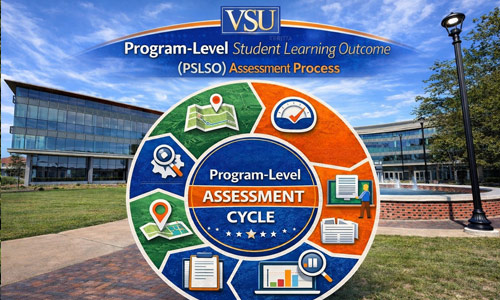
The assessment process at VSU is a systematic and ongoing cycle designed to promote the continuous improvement of academic programs. It involves the assessment of the level of student performance at the pre-determined Program-Level Student Learning Outcomes (PLSLOs). This process of identifying expected PLSLOs is faculty driven and is developed, coordinated, assessed, and reviewed collaboratively by the faculty members in each academic program or department. The process is informed by both internal and external requirements, academic guidelines, and industry best practices. Each school and/or program accredited by external professional accrediting agencies take into consideration the requirements for its respective programs as stipulated by their accrediting bodies when identifying student learning outcomes. The flow-chart diagram below is the VSU Assessment Cycle. It illustrates a continuous assessment and improvement cycle.
Virginia State University Assessment Cycle
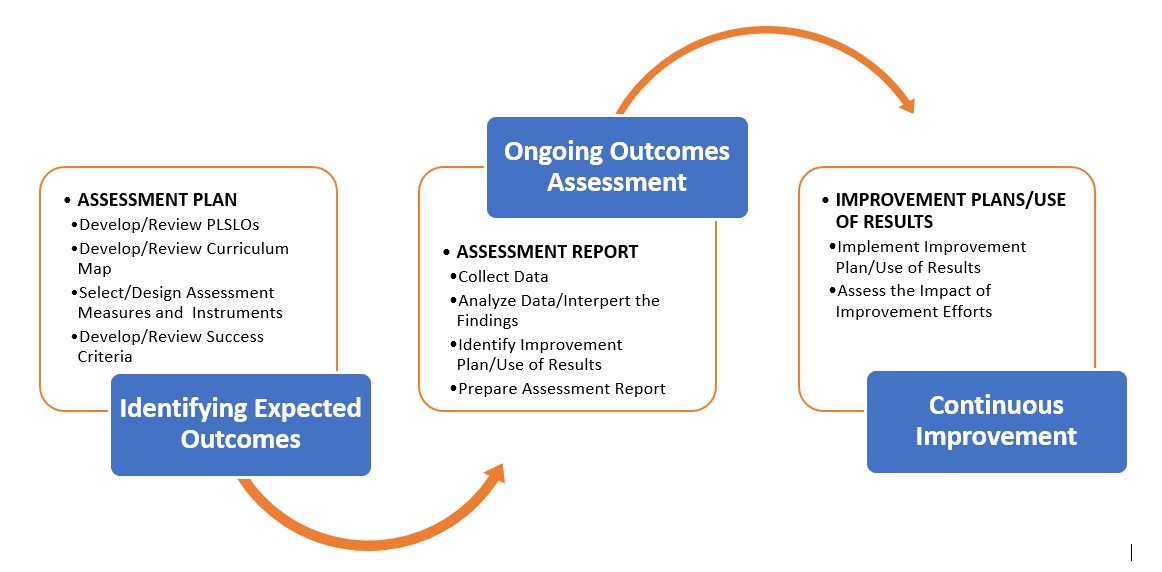
The assessment and improvement cycle begins with Identifying Expected Outcomes, which involves developing or reviewing existing Program Level Student Learning Outcomes (PLSLOs). The process is informed by both internal and external requirements, academic guidelines, and industry best practices. During this stage, faculty also develop or review the curriculum map to ensure alignment between learning outcomes and course offerings. Appropriate assessment measures and instruments are selected or designed, and clear success criteria are established. These steps collectively form the program’s Assessment Plan.
Once the expected outcomes are defined, the process moves into Ongoing Outcomes Assessment. In this phase, data are collected based on the selected measures. Faculty then analyze and interpret these data to determine how well students are meeting the intended learning outcomes. Based on the findings, an improvement plan is identified, and the results are documented through a formal Assessment Report.
The cycle continues with Continuous Improvement, where the identified improvement plan is implemented. Programs use the results gathered from the assessment report to guide decisions and actions aimed at strengthening student learning. After implementing these changes, the impact of the improvement efforts is evaluated to determine their effectiveness.
Together, these phases form a continuous improvement spiral model of planning, assessing, and improving, ensuring ongoing enhancement of educational quality.
VSU Assessment and Improvement Cycle
|
Phase |
Component |
Key Activities |
|
Identifying Expected Outcomes |
Assessment Plan |
Develop/Review PLSLOs (Program-Level Student Learning Outcomes) |
|
Develop/Review Curriculum Map |
||
|
Ongoing Outcomes Assessment |
Assessment Report |
Select/Design Assessment Measures and Instruments |
|
Develop/Review Success Criteria |
||
|
Collect data |
||
|
Analyze Data / Interpret Findings |
||
|
Identify Improvement Plan / Use of Results |
||
|
Prepare Assessment Report |
||
|
Continuous Improvement |
Improvement Plans / Use of Results |
Implement Improvement Plan / Use of Results |
|
Assess the Impact of Improvement Efforts |